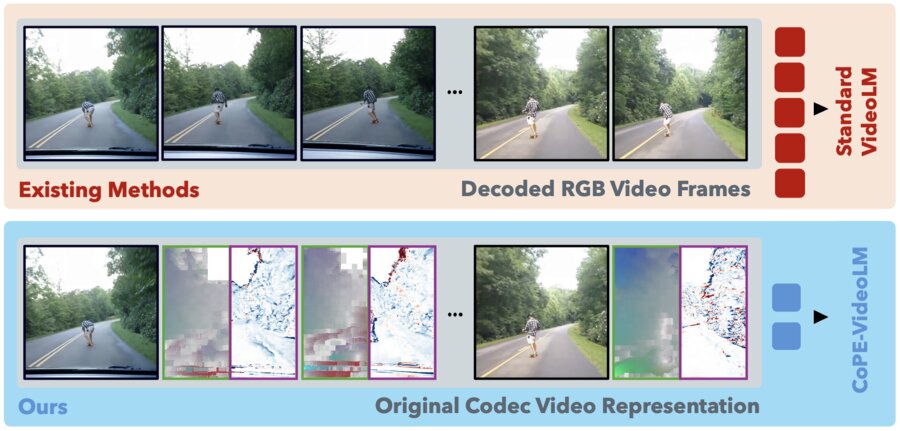
CoPE-VideoLM: Leveraging Codec Primitives for Efficient Video Language Modeling
Uses video codec primitives instead of dense per-frame embeddings, cutting time-to-first-token by up to 86% and tokens by up to 93%.
I am a 2nd 3rd-year PhD student (2024–) in the Gradient Spaces Group at Stanford University, advised by Prof. Iro Armeni (part of Stanford Vision and Learning Lab - SVL). During my PhD, I have interned at Waymo Perception (Summer ’26) and Microsoft Spatial AI Lab (Summer ’25). I am partly supported by a Google XR grant on 4D understanding.
My research focuses on spatial intelligence and multimodal video understanding. I build efficient visual representations that capture space and time, align real-world 3D scenes across modalities, and enable controllable built-environment generation.
Before PhD, I received my M.Sc. in Computer Science from ETH Zurich, advised by Prof. Marc Pollefeys, during which I interned at Qualcomm XR working on real-time SLAM. Earlier, I was a computer vision research engineer at Mercedes-Benz R&D and spent a year in Prof. Vincent Lepetit's lab at TU Graz working on hand-object pose estimation.
Recognized as a Top Reviewer at NeurIPS 2026 📝✨
CoPE-VideoLM (lead author) and GraphWrit3R accepted to NeurIPS 2026. See you in Paris 🇫🇷🌏✈️
I joined Waymo Perception (Mountain View) as a research intern, working on streaming temporal reasoning.
Recognized as an Outstanding Reviewer at CVPR 2026 📝✨
Invited talks on “Codec Primitives for Efficient Video Understanding” at Google DeepMind and Valeo AI in Paris.
CoPE-VideoLM is out: efficient codec-aware tokenization for video understanding.
Invited talk on GuideFlow3D at Voxel51 Best of NeurIPS.
GuideFlow3D accepted to NeurIPS 2025. See you in San Diego 🇺🇸🌴
Invited talks on “Scalable Cross-Modal 3D Scene Understanding” at Google XR Research and Imagine Lab.
I joined Microsoft Spatial AI Lab (Zurich) as a research intern, working on efficient video tokenization.
CrossOver accepted to CVPR 2025 as a Highlight. See you in Nashville 🇺🇸🎸
Career update I joined Stanford University as a PhD student in Computer Vision.
I joined Qualcomm XR (Amsterdam) as a research intern, working on real-time SLAM for extended reality.
SGAligner accepted to ICCV 2023. See you in Paris 🇫🇷🥐
I started my MSc in Computer Science at ETH Zurich.
Keypoint Transformer accepted to CVPR 2022 as an Oral. See you in New Orleans 🇺🇸🎷
I joined Mercedes-Benz R&D as a Computer Vision Research Engineer.
Monte Carlo Scene Search accepted to CVPR 2021 🎉
General 3D Room Layout from a Single View by Render-and-Compare accepted to ECCV 2020 🎉
I started as a Research Assistant at IVC, TU Graz with Prof. Vincent Lepetit, supported by a Qualcomm fellowship.
Efficient visual encoders for spatial and video understanding.
Guiding pre-trained generative models to control shape and appearance.
Structuring and aligning real-world environments across modalities.
* Equal contribution · † Equal supervision
Uses video codec primitives instead of dense per-frame embeddings, cutting time-to-first-token by up to 86% and tokens by up to 93%.
Writes complete 3D scene graphs as structured JSON directly from point clouds, Gaussian Splats, or both, without ground-truth object annotations.
Training-free 3D generation from geometric primitives, with per-part control over shape adherence and part-specific text or image appearance cues.
A feed-forward model that predicts movable parts and joint parameters of articulated objects from a sparse, unordered set of partial point clouds.
Extends SGAligner with open-vocabulary cues and learned joint embeddings to align 3D scene graphs across modalities, even under low overlap and sensor noise.
Cross-modal alignment method for 3D scenes that learns a modality-agnostic embedding space, enabling scene-level alignment without semantic annotations.
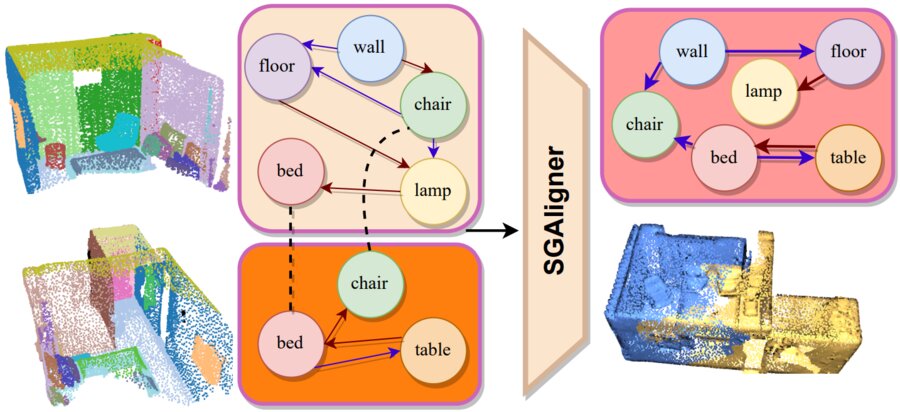
3D Scene Graph Alignment robust to in-the-wild scenarios powering point cloud registration and map integration.
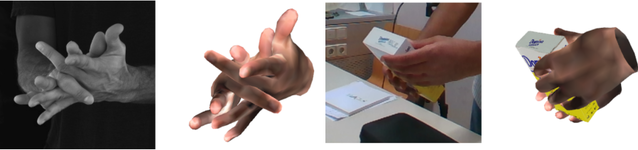
Efficient network for two-hand and object pose estimation in complex interactions, paired with the H2O-3D dataset of two-hand interaction with YCB objects.
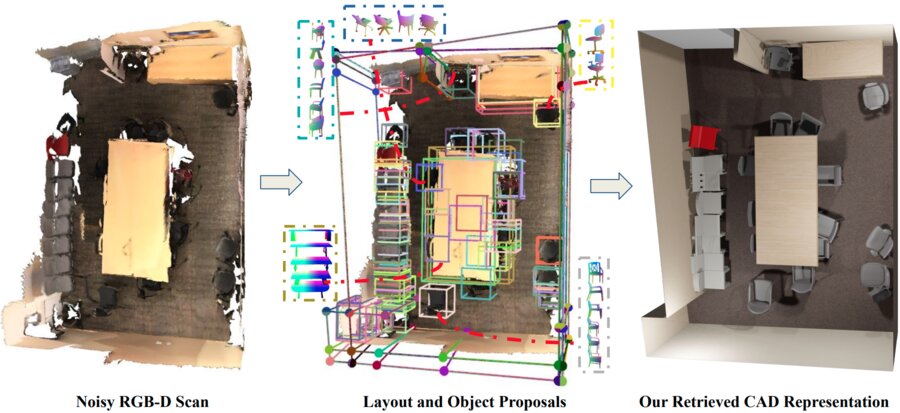
Monte-Carlo Tree Search (MCTS) based analysis-by-synthesis method to recover complete scene (3D layout+objects) from a noisy RGB-D scan.

3D layout estimation from a single perspective view, to recover complex non-cuboid layouts by solving a constrained discrete optimization problem.
Get in touch
I’m always open to research collaborations. If you’re around the Bay Area, let’s grab a coffee!